
On doing ‘being a victim’. Sulla titolarità dell’esperienza della vittima nella slam poetry
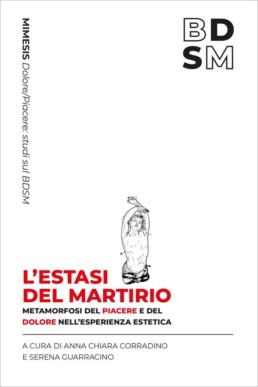
“On doing ‘being a victim’. Sulla titolarità dell’esperienza della vittima nella slam poetry” in L’estasi del martirio, Milan: Mimesis, 2025 (book chapter).
Poetry slam, which involves a format for a performance poetry competition with a popular jury, constitutes a hybrid frame: a ‘forum’ that moves between competition, ceremony and fiction, influencing the content and form of the performances. Several scholars (Somers-Willett, Novak, Ailes) have observed that the constraint that the performer must be the sole author of the text establishes a pact of authenticity with the audience as a preliminary agreement, with the consequence that the self of the poem is generally associated with that of the performer. If, in contemporary culture, a conception of authorship linked to the effect of the writer’s physical presence plays an increasingly central role, as demonstrated by Cangiano (2024) and Giglioli (2014), culture wars and victim identity guarantee a salient story to tell.
Drawing on queer studies and an interdisciplinary approach, this contribution aims to investigate how slam poets performatively construct the identity of the victim. In performances, characterised mainly by everyday and direct language, the assumption of the parrhesiast’s stance, speaking on behalf of a marginalised community, the use of ‘strategic essentialism’ (Spivak) and the self-representation of one’s artistic figure as a ‘change-maker’ or ‘artivist’ are relevant.
But what happens when the victim is played by someone who does not have the necessary experience (Sakcs 1984) to bring a stigmatised identity to the stage, someone who is ‘without trauma’ (Giglioli 2011)? Furthermore, can these performances produce real change or do they merely confirm power structures, fulfilling a need for agency that is relegated to the moment of performance without any consequences in practice? Through a series of examples, this article reflects on the representation of cultural conflicts in slam poetry and on the social and political consequences in the relationship between performer and audience.

Frame Analysis of Poetry Slam
“Frame Analysis of Poetry Slam” in Marc Matter, Henrik Wehmeier and Clara Cosima Wolff (eds.): Audioliterary Poetry between Performance and Mediatization Berlin, Boston: De Gruyter, 2024, pp. 93-112.
https://doi.org/10.1515/9783111561356-005 (book chapter).
Description coming soon.
Check out my book “The Aesthetic Response in Poetry Slam: Frame Analysis and Performance Phenomenology” for more information about the article content.
Performance Poetry of the 2000s: Trans-autorship and Trans-mediality in the Italian Spoken Word Poetry
“Performance Poetry in the 2000s: Trans-Authoriality and Transmediality of Spoken Word Poetry in Italy” (“La poesia performativa degli anni 2000. Trans-autorialità e trans-medialità della Spoken Word Poetry in Italia”)
Università dell’Aquila & Université de Lausanne (CH)
Directors: Serena Guarracino (Università dell’Aquila); Camille Vorger (Université de Lausanne)
Co-director: Massimo Fusillo (Scuola Normale Superiore – Pisa)
Abstract
This doctoral project aims to map the Italian contemporary slam and spoken word poetry scene (2001–2025), situating it in comparison with international contexts. The study is guided by three principal analytical questions: What is performative poetry? How can it be studied? And how is it published?
The research focuses on the different modes of publication—live performance, print, and digital formats—and seeks to contribute to the historicization of these oral works, often ephemeral and at risk of being forgotten.
Moreover, the project proposes a methodological framework grounded in interdisciplinary approaches, including performance studies, the sociology of literature, and practice-based research. Through an autoethnographic perspective, it examines trans-authorial and transmedial creative practices, encompassing collective composition, collaboration with AI, and audience participation. The study also addresses the challenges of canonization and archiving of these ephemeral, popular, and countercultural artistic forms, highlighting the political and ethical engagement of the artists involved.
The Aesthetic Response in Poetry Slam: Frame Analysis and Performance Phenomenology
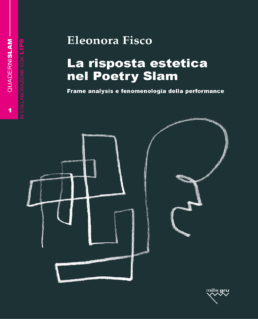
“La risposta estetica nel Poetry Slam. Frame analysis e fenomenologia della performance”
Published by Mille Gru Edizioni
Preface Paolo Giovannetti
Afterword Giuliano Logos
Series Quaderni Slam
In collaboration with LIPS, Italian Poetry Slam League
ISBN 978-88-946947-0-3
The cultural phenomenon of poetry slam was born in Chicago and today is widespread all over the world. This is a new poetic practice that involves a fixed format for a competition of performed poetry. There are few simple rules: every poet has three minutes to propose his/her performance; costumes, music and props are not admitted; texts have to be original; the jury is strictly popular and five people randomly selected among the public compose it.
This work aims to analyse the Italian slam scene through the application of Erving Goffman’s Frame analysis (1974) hermeneutic tools and through the reader-response criticism interpretative approach. The final objective is to understand how slammers create their performances having in mind a certain implied audience (Iser, 1978).
After a brief historical presentation of the movement, this research is divided in two chapters. The first is about the frame analysis of poetry slam that is the definition of the social situation created in the event that influences the public’s expectations. The second chapter focuses on the phenomenology of the performance staged by the slammers, through an actualization of Wolfang Iser’s theory of aesthetic response that examines the construction of the meaning created by the relation between text and reader. In addition, the author proposes a categorization of the most representative slam styles based on the criterion of the effect that the performers try to stimulate on their audience.
Through her experience as a slammer, an organizer and a spectator of many poetry slams and the interviews to some of the main figures of the national scene, in this book Eleonora Fisco proposes the first ethnographic study of the Italian poetry slam published in Italy.