
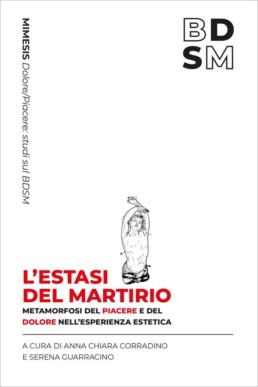
“On doing ‘being a victim’. Sulla titolarità dell’esperienza della vittima nella slam poetry” in L’estasi del martirio, Milan: Mimesis, 2025 (book chapter).
Poetry slam, which involves a format for a performance poetry competition with a popular jury, constitutes a hybrid frame: a ‘forum’ that moves between competition, ceremony and fiction, influencing the content and form of the performances. Several scholars (Somers-Willett, Novak, Ailes) have observed that the constraint that the performer must be the sole author of the text establishes a pact of authenticity with the audience as a preliminary agreement, with the consequence that the self of the poem is generally associated with that of the performer. If, in contemporary culture, a conception of authorship linked to the effect of the writer’s physical presence plays an increasingly central role, as demonstrated by Cangiano (2024) and Giglioli (2014), culture wars and victim identity guarantee a salient story to tell.
Drawing on queer studies and an interdisciplinary approach, this contribution aims to investigate how slam poets performatively construct the identity of the victim. In performances, characterised mainly by everyday and direct language, the assumption of the parrhesiast’s stance, speaking on behalf of a marginalised community, the use of ‘strategic essentialism’ (Spivak) and the self-representation of one’s artistic figure as a ‘change-maker’ or ‘artivist’ are relevant.
But what happens when the victim is played by someone who does not have the necessary experience (Sakcs 1984) to bring a stigmatised identity to the stage, someone who is ‘without trauma’ (Giglioli 2011)? Furthermore, can these performances produce real change or do they merely confirm power structures, fulfilling a need for agency that is relegated to the moment of performance without any consequences in practice? Through a series of examples, this article reflects on the representation of cultural conflicts in slam poetry and on the social and political consequences in the relationship between performer and audience.